


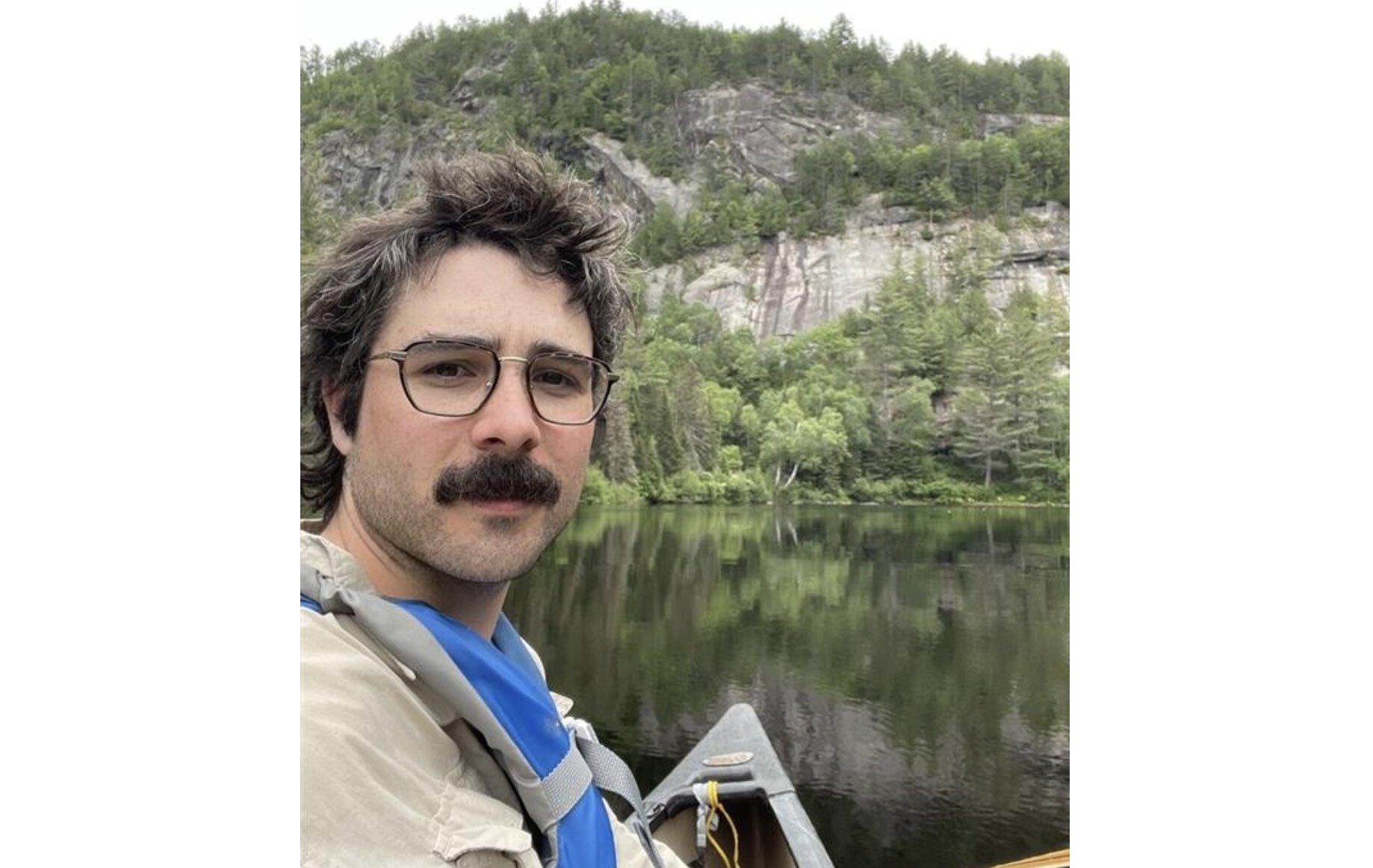
As Penser l'eau autrement, a regional forum in Gatineau, confronted a future of more frequent flooding across the Ottawa River watershed, MRC de Pontiac environment coordinator Jacob Demers traced the region's high water back through a century of building in the floodplain and into a warming climate that is turning snow into rain. Photo: Courtesy
A Pontiac biologist takes the long view at a regional water forum
Tashi Farmilo
For people in Aylmer, Mansfield, Quyon, Gatineau and across the Pontiac, the question after every spring flood is the same: why does it keep happening? Jacob Demers, the Environment Coordinator for the MRC de Pontiac, spent June 4 at a regional forum in Gatineau working through an answer locals may not want to hear. The water is not going away, and a warming climate is loading the odds against the region.
Demers was at the Château Cartier as a representative on the Table de concertation de la rivière des Outaouais, which organized the forum, Penser l'eau autrement, with the five watershed organizations covering the basin. It drew officials from more than 150 municipalities, regional county municipalities and Indigenous communities. Coordinator Janie Larivière was blunt: treating the floods of 2017, 2019 and 2023 as freak events would be wishful thinking when their frequency may be the new reality.
Demers answers with history that starts a century before any climate model. "You look at all the historic homes, the centennial homes, and none of them are built below the flood line," he said. "They knew something." His own house on Isle-aux-Allumettes was built by his great-grandparents in 1902, well above the 100 year high water mark. "The proof is in the soil," he said, pointing to where the river once reached.
This spring came close to that old memory. The water rose near the levels of 2023, though Demers is careful to say it set no record. People in Mansfield were affected, streets closed, and the covered bridge was shut for a stretch. "Obviously it has to do with precipitation," he said, "but it's a multifaceted thing."
Part of that complexity is human. Before the dams went up on the Ottawa, flooding ran "way beyond what we've seen even in 2019," he said. The dams made the river more predictable, and people began building closer to the water than their ancestors would have. After a 1979 flood wiped out homes, infilling took hold, raising land into dry islands within the flood zone. "A lot of those people hadn't flooded in 2019," he said. But the infill erodes, forcing owners to build retaining walls.
The pull to the shoreline was cultural too. His grandparents went to the river twice a year, "for the cows to drink. It wasn't like they needed the view." That changed with the vacation homes of the 50s, 60s and 70s. "Disposable income, people wanted to build close to the water, regardless of if you're putting yourself at risk."
Quebec has now moved to close that door, with new rules since March 1, barring construction in the highest-risk zone. Demers welcomes the shift but keeps it in perspective. "It'll help homeowners," he said, "but it's another measure. It doesn't stop the flooding itself."
The cause that worries him most no bylaw can reach. The region is getting less snowpack, he said, but the water still comes. "It's going to come in rain form, in shorter periods, early spring thaw, big rains in early April where it would have been snow before." Forum projections for the MRC de Pontiac showed winter rainfall rising steeply.
He measures the change against his own thirty years. He has never seen an ice road across the river to Pembroke, though his father remembers one that stood for years. "The ice is a lot thinner now," he said. Summers have changed too. "I grew up with seven kids in our home and never had AC. The breeze was enough." His parents added AC only five or six years ago. "Temperatures are 40 degrees."
Demers came to the file as a wetland biologist, with a master's from Mount Allison University and stints at Parks Canada and Ducks Unlimited Canada before returning to the Pontiac in 2024. He studied in Sackville, New Brunswick, a town that survives behind dikes, where the talk kept turning to rising seas. He understands water that has to be held back.
For Demers, the houses on the high ground were a form of adaptation, made by people who read the land. The same work now falls to this generation. "The sad reality is there's obviously adaptation that has to happen," he said.