


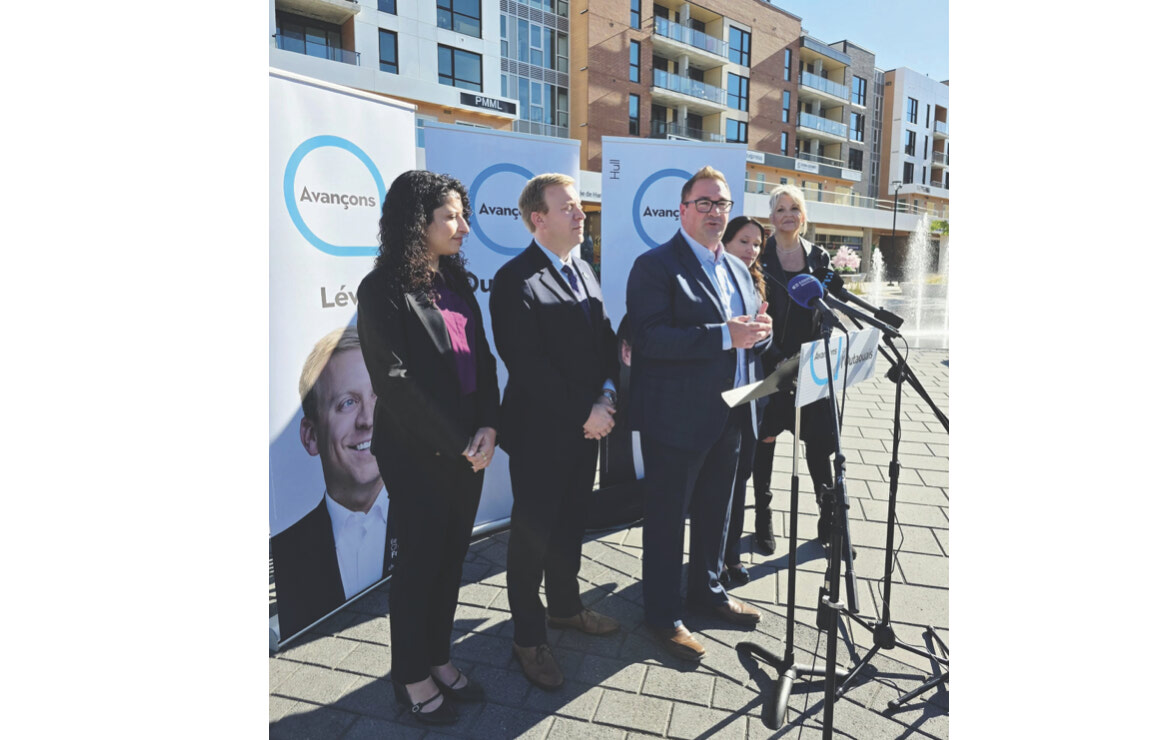
Coalition Avenir Québec candidates Mariana Mefleh, Mathieu Lévesque, William Robertson, Suzanne Tremblay and Linda Gauthier, from left, present the party's plan for a regional approach to vehicle registration and tax residency at the Agora in Aylmer's Plateau district on September 25. Photo: Tashi Farmilo
CAQ promises regional approach to Ontario plates in the Outaouais
Tashi Farmilo
The five Outaouais candidates for the Coalition Avenir Québec (CAQ) were in Aylmer on September 25 with a message of fairness, promising that a re-elected CAQ government would push to bring the region's rural municipalities into the effort to ensure residents who live in Quebec register their vehicles and pay their taxes here.
Standing outside the Agora in the Plateau district, Hull candidate Suzanne Tremblay described the issue as a product of geography. With only the Ottawa River between two provinces, she said, the proximity that serves the region so well also makes it easy to settle on the Quebec side while keeping one's paperwork in Ontario. Tremblay, who is seeking a second term, said the subject still comes up often when candidates knock on doors.
She stressed that plenty of Ontario plates on local streets are there legitimately, belonging to students or company vehicles, for example. The concern, she said, is with people who have made Quebec their home without updating their tax residency and vehicle registration to match.
Tremblay cited an independent study produced with the support of the Observatoire du développement de l'Outaouais, which used an overnight count of licence plates to estimate how many homes in the Plateau and northern Mitigomijokan districts might be occupied by people filing taxes in Ontario. It arrived at roughly 13.6 per cent overall, with the share highest in large apartment buildings. Its authors recommended extending the analysis to other parts of the region, cross-referencing available data and tracking the situation over time, an approach Tremblay said shaped the party's proposal.
Gatineau already has a system in place. Since city police began accepting reports through 311, more than 2,800 have come in and over 200 files have been forwarded to Revenu Québec, which has a team devoted to tax residency, Tremblay said, while acknowledging that reviewing cases one at a time slows the process. According to the party, the province has recovered more than $28.5 million in gross tax revenue in this area since 2019-2020, and Revenu Québec sent hundreds of letters in 2025 and 2026 to taxpayers considered at risk, encouraging them to get their situation in order.
The CAQ's commitment would take that model beyond city limits. Gatineau candidate William Robertson, a La Pêche resident running for the first time, said months of door-knocking convinced him the question reaches well into the rural Outaouais. A CAQ government would recommend that representatives of the other affected regional county municipalities join the committee the City of Gatineau and the SAAQ formed in 2024, widening its mandate to the whole region. It would also aim to improve co-ordination between Revenu Québec, the SAAQ, police forces and the MRCs, align their work on the ground, continue public awareness efforts and look for ways to make interventions simpler and faster.
Robertson echoed Tremblay's caution that a plate from another province does not in itself signal wrongdoing and that every situation must be judged on its facts. Most residents follow the rules, he said, but when a case is found to be out of compliance, the agencies involved should be able to act together. He framed the proposal as a matter of equity for those who already contribute and said a CAQ government would meet with regional partners soon after the October 5 election to settle on concrete improvements.
Tremblay fielded questions from reporters. In Gatineau, she said, city police would continue to investigate based on public reports, while in the MRCs the goal would be to work with local police forces to harmonize procedures and determine what resources they need.
Asked by the Aylmer Bulletin about the party's plans for the Aylmer sector, Tremblay said the work already underway with the City of Gatineau, including police investigations, would continue there. The difference, she said, would come from applying the study's findings through closer co-ordination and better data sharing, which she argued would recover more revenue for education and health care.
Pressed on why a party holding four of the region's five seats had not acted sooner, Tremblay said the existing committee is already producing results, and the next step is to widen it and make data easier to access, given how long and complex investigations can be. On what was at stake financially, she cited from memory an estimate of about $50 million in additional revenue from the study, though its authors presented their economic figures as hypothetical scenarios.
When a reporter asked whether the plan amounted to encouraging neighbours to report one another, Tremblay said the emphasis was on informing people rather than suspecting them.
Newcomers from Ontario are adjusting to a new province, she said, and should not be presumed to have bad intentions. Under Quebec's Highway Safety Code, new residents have 90 days to register their vehicle with the SAAQ.