


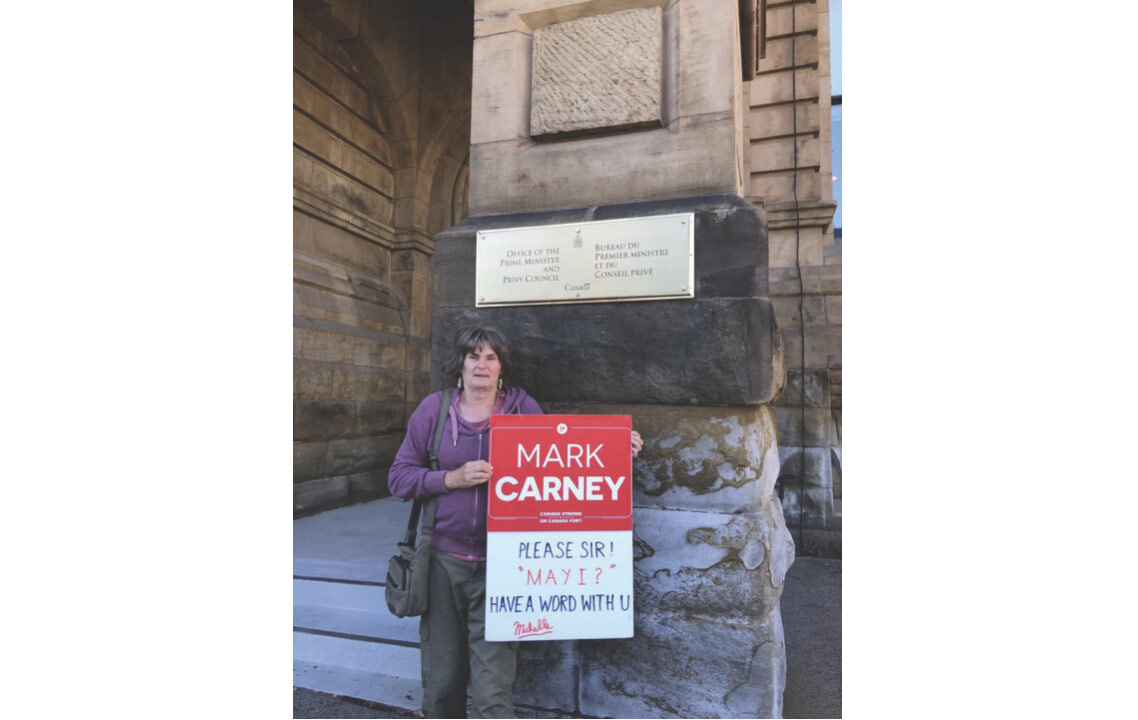
Michelle Goodman, Trans rights advocate, in front of the Office of the Prime Minister and Privy Council in Ottawa. Photo: Courtesy
Dismissed and ignored: A trans rights advocate's experience fighting for accessible gender-affirming care
Sophie Demers
Transgender rights advocate, Michelle Goodman, has been fighting to make gender-affirming care accessible to gender diverse Canadians. Although the Canadian government recognizes trans individuals and states that everyone, regardless of gender identity should have access to the care and support needed to live a happy, healthy life, Goodman says the reality is that trans individuals face significant obstacles when seeking the care they need.
Gender-affirming care encompasses all social, medical, psychological, and legal interventions that allow trans individuals to live authentically. According to Max - Ottawa Community Health, “Gender-affirming care” is among the simplest, most impactful, and the least available aspects of healthcare affecting our community. We know that trans people experience the highest rates of harm — including suicidality — while waiting to access gender-affirming care but also see the most dramatic turnaround in health outcomes once they start care.”
Goodman experienced firsthand the barriers to care in Canada, when she attempted to medically transition. After retiring at age 65, Goodman realized she would not hide any longer; she needed to be her true self. “I was always trans, but I had to bury that part of myself. It wasn’t safe.”
Depending on the province, some procedures and services are covered; however, many are not. In both Ontario and Quebec, it would take approximately 3 to 5 years to fully medically transition and costs anywhere from 60k to 120K. Goodman said she couldn’t wait for the procedures and decided to pay for them in Thailand where it only took six weeks. “I needed to transition physically. I couldn’t live without it,” said Goodman. “People assume it’s just cosmetic surgery but for trans people it’s lifesaving.”
Now living authentically as her true self, Goodman has dedicated her life to helping the trans community. She started at the provincial level in both Quebec and Ontario, petitioning the provinces to cover the costs of gender-affirming care and make it more accessible. “Between the Ford and Legault government, I couldn’t get anyone to speak with me. They wouldn’t listen. I was completely ignored.”
After this dismissal, Goodman decided to focus on the federal government. She contacted every Member of Parliament she could but only received real support from Greg Fergus, MP for Hull - Aylmer, and Yasir Naviq, MP for Ottawa Central. Fergus gave Minister of Health Majorie Michel, a handwritten letter by Goodman outlining her work and her petition for accessible care. “Her response was that she understood the issues, and she would respond to me. She said she would do her best. I never got a response to that. It has been six months now.
Most recently, Naviq wrote a letter of support to the minister asking for support, and finally Goodman received a response from Michel. In response, the Minister stated that the law regarding gender-affirming care is intentional as it is the province’s responsibility.
“The most frustrating part of the Minister's response is that it claims they can't define what is medically necessary,” said Goodman. “They have no problem doing exactly that when they want to launch a new program like the national dental plan or pharmacare. They are using a technicality—the ‘intentional vastness’ of the Act—to avoid a political fight with the provinces. It’s a ‘pass the buck’ strategy that leaves thousands of others in a legal grey zone where your healthcare is treated as an optional ‘extra’ rather than a fundamental right.”