


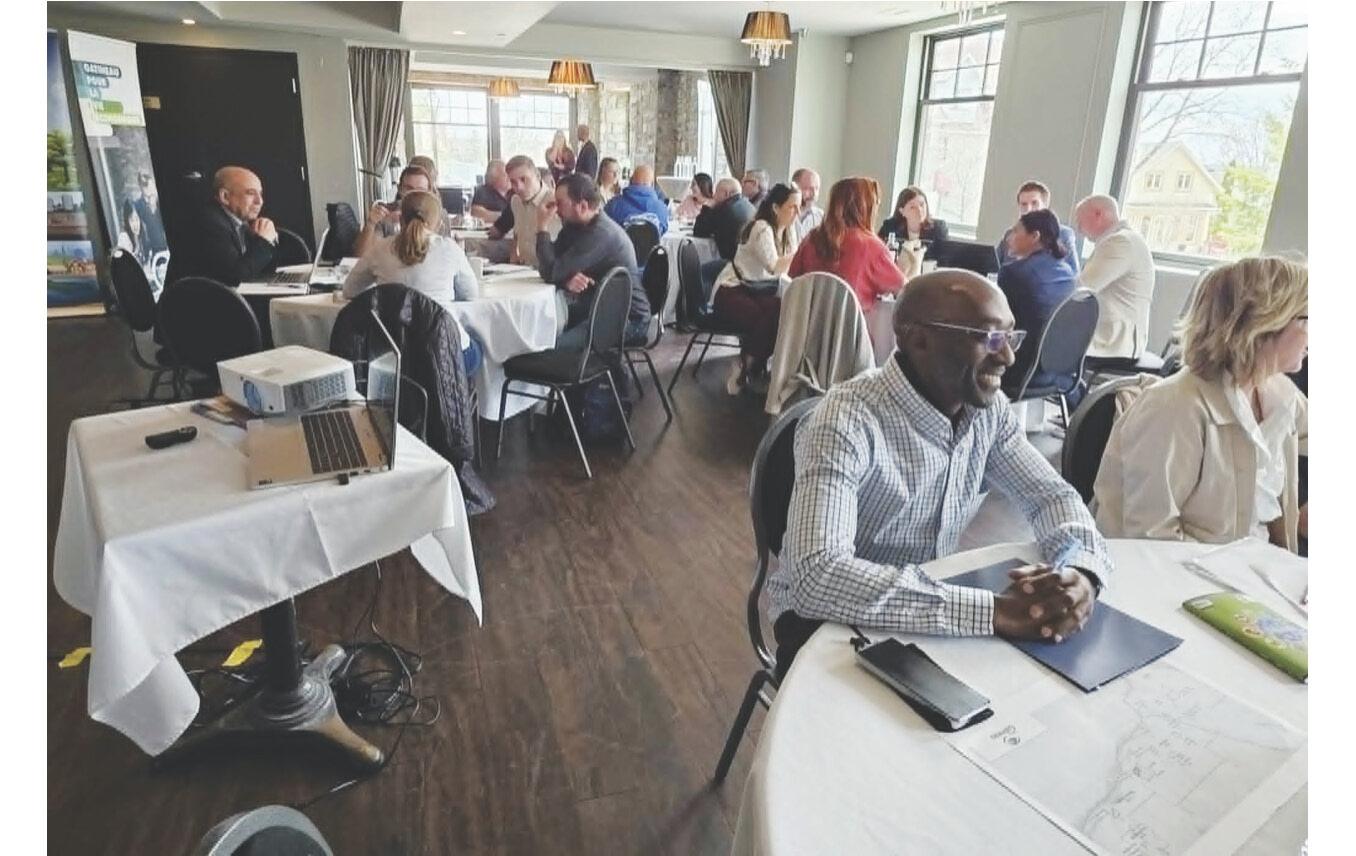
Gatineau is running out of industrial land, losing ground on tax revenue, and struggling to shed its civil-servant image, and the city is now asking the business community to help chart a way forward. Photo: Tashi Farmilo
Gatineau holds industrial development consultation workshop in Aylmer
Tashi Farmilo
Gatineau is running out of industrial land, losing ground on tax revenue, and struggling to shed its civil-servant image, and the city is now asking the business community to help chart a way forward.
The city brought together manufacturers, real estate developers, and community stakeholders at The British in Aylmer on April 23 for a two-hour conversation about the future of its industrial economy. It was the second of two workshops, the first having taken place the previous morning at the Grand Hangar of Collège Select Aviation at the Gatineau Airport. Both sessions were managed by the planning firm LGP, mandated by the city to develop a comprehensive industrial strategy, and were made possible in part through $65,000 in funding from the Quebec Ministry of Economy, Innovation and Energy.
Tiffany-Lee Norris Parent, the Action Gatineau councillor for the Touraine district (District 11) and chair of the economic development commission, opened the afternoon session. Elected in 2021, she said she had pushed for this process herself, arguing that Gatineau has good tools at its disposal but lacks a coherent direction for using them. LGP facilitators divided the room into four tables representing industrial actors and manufacturers, real estate developers, other participants, and interest groups.
The numbers they presented were stark. Gatineau has grown past 300,000 residents, but that growth has been almost entirely residential. One in four jobs is tied to public administration, while industry accounts for just over 10 per cent of employment. The industrial and commercial share of the city's standardized property wealth has fallen from roughly 18 per cent in 2019 to 12 per cent in 2025, leaving 86 per cent of that base in the residential sector. The practical consequence is that homeowners are picking up a growing share of the municipal tax burden, and the trend is moving in the wrong direction.
The land picture compounds the problem. Gatineau has 14 industrial parks, but usable parcels are nearly exhausted. A prior study found that buildings occupy on average only 19 per cent of the land in those parks, well below comparable cities, pointing to chronic underutilisation of the space that does exist. What remains theoretically available is largely encumbered by environmental constraints: wetlands, landslide-prone terrain, and similar obstacles for which the current regulatory framework offers businesses little guidance or flexibility. At current rates of demand, the City's municipal industrial land supply could be gone within five to ten years. The airport industrial park, with its highway access and proximity to the runway, is the single largest remaining reserve, but even its last parcels are reportedly already in advanced negotiations.
What emerged from the afternoon discussion was less a catalogue of grievances than a pointed diagnosis, one that participants appeared to believe is treatable if the city is willing to act on it.
The most immediate concern was the absence of a coordinated welcome for incoming business. The tables called for a genuine "red carpet" system capable of answering an investor's practical questions from first contact, citing as an example the basic inability to confirm, at the outset, whether a given site has sufficient electrical capacity for a proposed use. Power reliability was raised as a specific disqualifier for sectors such as pharmaceuticals and agri-food, where outages carry consequences that go well beyond inconvenience.
Regulatory process drew pointed criticism. Beyond the challenge of developing environmentally constrained land, participants described a broader environment of too many steps, too little flexibility, and too few clear answers. The consensus was that the city needs to reposition itself, moving away from the role of adjudicator and toward that of active development partner.
The image problem, however, may be the deepest challenge of all. Gatineau's reputation as a civil-servant city shapes how it is perceived by outside investors, but the tables were candid that the issue runs inward as well. The culture of caution associated with public-sector employment, they suggested, has permeated the city's approach to economic risk and business development. Overcoming it will require more than a marketing refresh. The tables were clear that Gatineau must identify its priority industrial sectors, name them specifically, and commit to them with conviction. A pitch designed to appeal to everyone, they noted, ends up compelling no one.
On sectors, the discussion pointed toward advanced technology, circular economy and sustainable development, construction-related manufacturing, and prefabricated building components, with agri-food also on the table. Participants stressed that the starting point should be an honest inventory of what Gatineau already does well, building strategy around existing local capacity rather than importing ambitions with no roots in the community.
An unexpected note of opportunity emerged around federal public-service reductions. The anticipated contraction of the federal workforce, while a challenge for the region, was seen as a potential source of skilled workers for private industry, provided the jobs Gatineau creates are good enough to keep educated people from leaving the city entirely.
The broader attraction argument, participants discussed, cannot rest on industrial parks alone. Quality of life, including accessible green space, a lively and well-maintained downtown, good restaurants, and proximity to outdoor recreation, were identified as genuine competitive assets that the city has been underselling. The parks themselves were described as needing investment in active transportation infrastructure, public transit links, and general amenity, the kinds of features that signal to workers and employers alike that a city takes its industrial future seriously. Aligning training and post-secondary programs with targeted sectors, and actively cultivating a culture of entrepreneurship, were also raised as long-term levers.
The workshops in Aylmer and at the Gatineau Airport represent the first of four phases in the City's process. Follow-up interviews with select economic stakeholders and an online questionnaire are to complete the consultation phase by May 2026. Results will go to the economic development commission in June. The completed strategy is to be validated by the commission and presented to city council in the autumn of 2026, with implementation of a priority action plan to follow in the winter of 2027.