


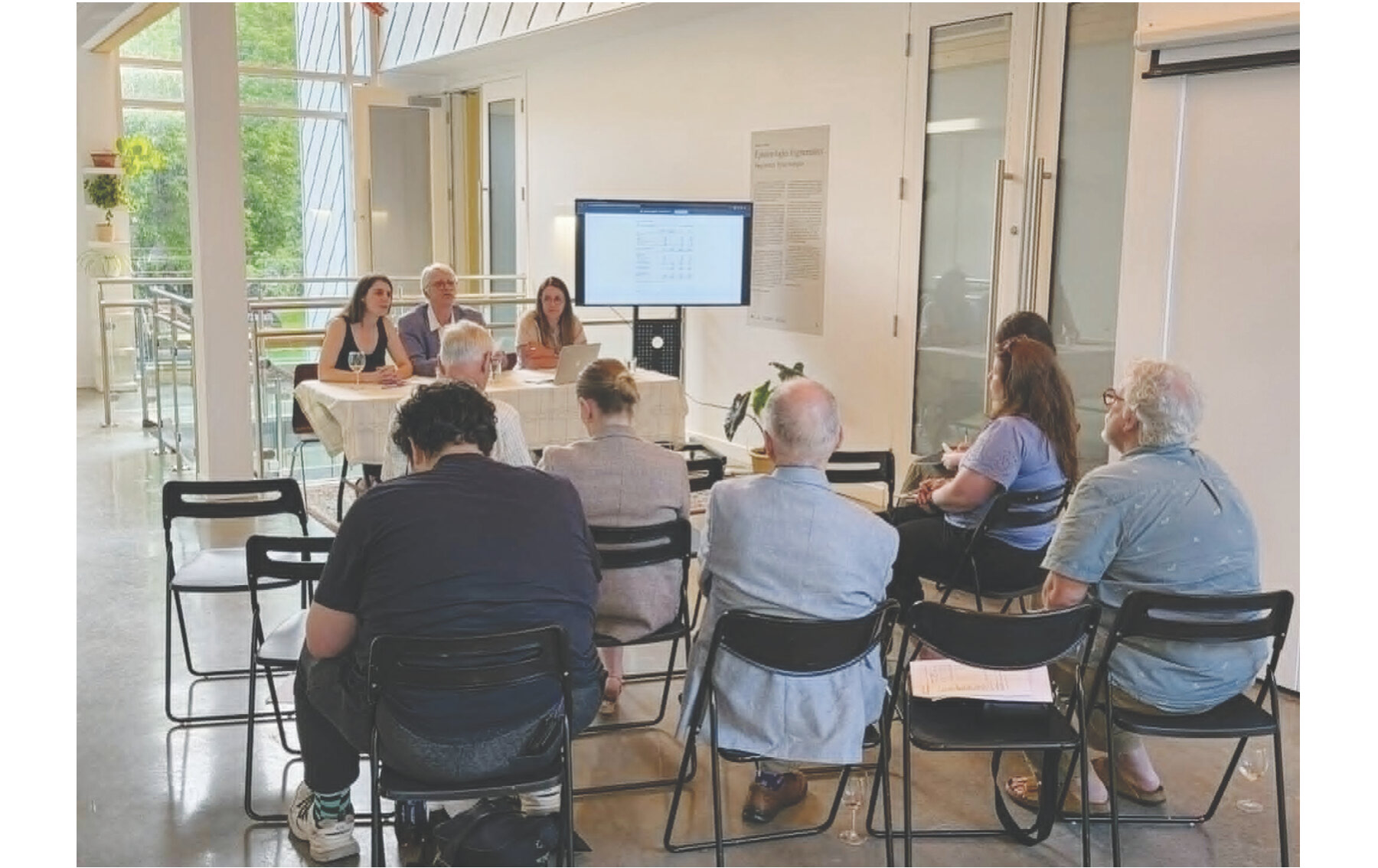
At its 2025-2026 annual general assembly, the Centre d'exposition L'Imagier reported swinging from a $39,505 deficit to a surplus of about $67,000, a recovery its leadership credited to deep cuts, unpaid labour and a 50th-anniversary season that still left the centre stretched thin. Photo: Tashi Farmilo
L'Imagier marks 50 years with a turnaround its treasurer calls hard-won
Tashi Farmilo
The Centre d'exposition L'Imagier held its 2025-2026 annual general assembly on June 17 in a hybrid format, presenting members with a financial turnaround that treasurer Nathalie Lapointe was careful to frame against the strain it took to achieve.
L'Imagier finished the fiscal year ended March 31, 2026 with an overall surplus of roughly $67,000, including an operating surplus of about $71,000. That reversed a deficit of $39,505 the previous year. Revenues rose to about $315,000 from roughly $266,000. Lapointe stressed that the numbers were the product of sacrifice rather than comfort. The centre operated all year without cash flow, she said, and its line of credit was already at its limit, leaving no margin to draw on. The organization ran at a deliberately smaller scale, with management tasks divided up and a heavy reliance on unpaid work.
Much of that strain traces back to the pandemic. Lapointe explained that L'Imagier had taken on a loan in order to repay the government in full for COVID-era support and preserve the grants attached to it. Those payments are now nearly complete, with the remaining capital, about $13,000, due over the coming year and the loan set to be fully settled by February. She described the repayment as the closing chapter of the COVID period.
Longtime member and artist Richard Perron, who has been involved with L'Imagier since 2010 and lived through the building's construction and the pandemic, reinforced the point. He said the organization had no choice but to live within its means and make difficult decisions, leaning on volunteers and parcelling out administrative duties among board members and staff to keep both the site and the programming alive. There is no joy in it, he said, but the bank account sets the limits.
Executive director Lou Walter was blunt about what that meant day to day. She spent much of the year as the centre's only staff member, a situation she called an enormous personal sacrifice, because L'Imagier could barely sustain a single employee. Several people contributed substantial time for free and could not be kept on. The centre hired someone to work alongside her only three weeks before the assembly, and Walter said the team would still need time to steady itself.
Set against that, the successes were real. Walter presented an annual report built around the centre's 50th anniversary, marked by two exhibitions, including one dedicated to founder Pierre Debain presented with the City of Gatineau, and a retrospective at L'Imagier. The year also included an exhibition tied to the PARCA conference of Indigenous curators, a music series in the Parc de l'Imaginaire, digital projections in the park supported by the City of Gatineau, and an eight-week summer art camp.
A benefit evening lifted the centre's autonomous revenues from about $5,000 the previous year to roughly $15,000. It featured an auction of works from the Debain family collection, with board member Simon Debain, a grandson of the founders, donating 70 per cent of the proceeds. Walter repeatedly credited Marysol Foucault for organizing the event and other initiatives, and introduced Amélie Rondeau as the new programming manager. On the funding side, she reported a $45,000 project grant from the Canada Council for the Arts and said securing core operating funding remains the central goal, a process requiring multiple applications, two of which have been accepted, with a third in progress.
Lapointe also told members that funders now require only a review engagement rather than a full audit, lowering costs and signalling confidence in the organization. The firm Lévesque Marchand Welch was retained again. The centre's assets, dominated by its building, total roughly $2.1 million.
The meeting was chaired by board president François Chalifour, with Daniel Casavant as assembly secretary. Four board seats were up for election under the organization's staggered terms, and Nathalie Lapointe, Fidèle Lavigne, Simon Debain and Catherine Nadon were re-elected by acclamation. The board now lists Chalifour as president, Jonathan Demers as vice-president, Lapointe as treasurer and Lavigne as secretary, with Debain and Nadon as administrators.
Member François Lachapelle, who described himself as a museum consultant who evaluates art centres across Canada, called the recovery rare in the sector while pressing the board to commit to better working conditions and competitive artist fees. He closed by proposing a motion of recognition for the board, staff and volunteers who carried the organization through the year, before moving to adjourn.