


Outaouais housing forum seeks to turn crisis talk into a regional action plan
Outaouais housing forum seeks to turn crisis talk into a regional action plan
Tashi Farmilo
Outaouais housing forum seeks to turn crisis talk into a regional action plan
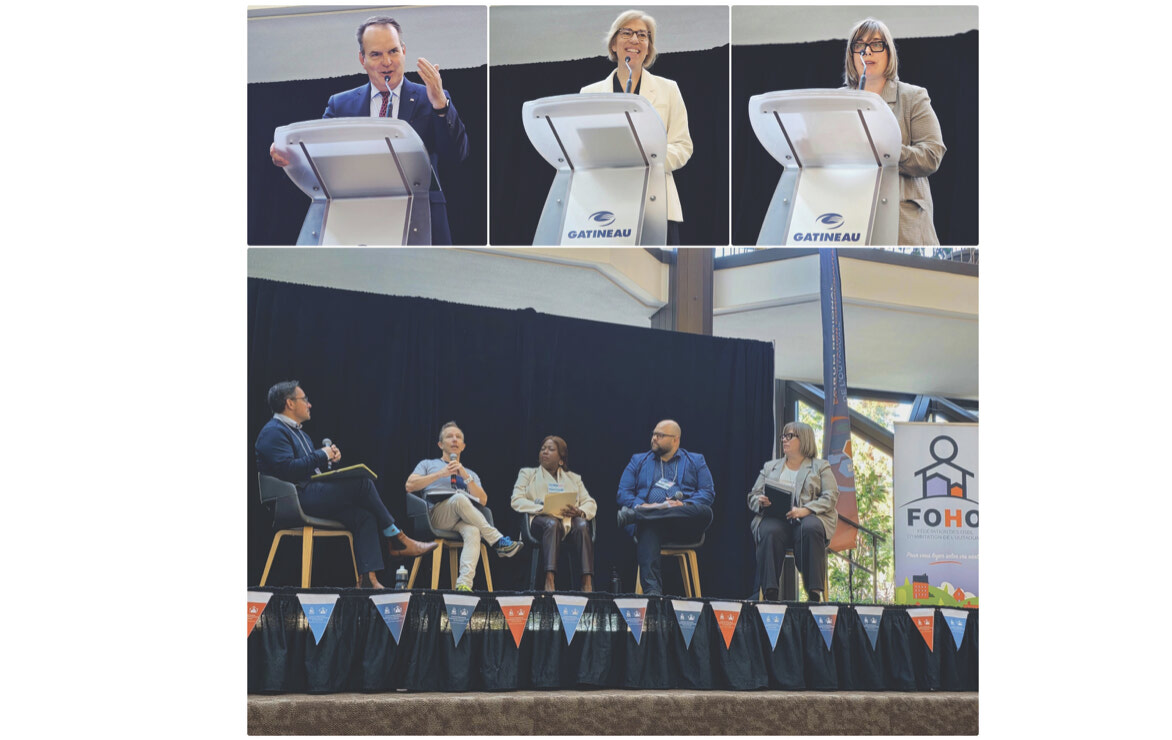
Social and community housing in the Outaouais took centre stage on September 23 at Gatineau's Maison du citoyen, where the Fédération des OSBL d'habitation de l'Outaouais (FOHO) brought together federal MPs, municipal officials, planners, non-profit groups and tenants for a daylong regional forum meant to move the region from diagnosing its housing shortage to acting on it. Organizers set out to build a shared factual portrait of the region's needs and to turn the day's discussions into recommendations, and those recommendations into concrete action.
Steven MacKinnon, the federal minister of transport, Leader of the Government in the House of Commons and Liberal MP for Gatineau, credited the non-profits in attendance with holding the sector together. "Community housing in the Outaouais stands because you hold it up," he said.
Living next door to Ottawa places unusual pressure on the local market and drives up the cost of living for Outaouais households, MacKinnon noted, citing a 268 per cent increase in homelessness in the region between 2018 and 2022. Two projects inaugurated in his riding since last spring have added 181 affordable units for vulnerable families, backed by more than $15 million in federal money, he said. His closing appeal was directed at elected officials, bureaucracies and society at large: "Please, act faster. Act with urgency. Act as though our future and our population depend on it."
Sophie Chatel, the Liberal MP for Pontiac–Kitigan Zibi, brought the rural picture into focus. In Maniwaki, she recalled, she visited a family living in sheds behind a house. Elsewhere, several families crowd into single units so tightly that children struggle to sleep. Federal funding exists, she said, but "the money has to find the projects," and that search starts with local organizations.
Rachel M. Deslauriers, the municipal councillor for the Mitigomijokan district and chair of the Commission du développement du territoire et de l'habitation, represented Mayor Maude Marquis-Bissonnette. She called affordable housing "the most effective tool to fight poverty," yet conceded that building it means navigating a process of 82 steps. "It's discouraging for everyone," she said.
Armelle Grey Tohouegnon, FOHO's general director, asked participants to judge their work not only by the number of units built but by how many people regain stability and dignity. "Behind every housing project, there is a life project," she said.
Throughout the morning, speakers kept returning to a paradox. On paper, Gatineau's rental market has loosened. The citywide vacancy rate reached 3.8 per cent in 2025, according to the Société canadienne d'hypothèques et de logement, the highest of any metropolitan area in Quebec and above the roughly 3 per cent generally considered balanced. New buildings sit at about 10 per cent vacancy, and some landlords are once again dangling a month or two of free rent. Yet in social, community and affordable housing, vacancy has hovered near zero for years.
"We have two completely different portraits," said Louis Sabourin, a housing consultant and former municipal councillor for the Limbour district.
The divide is also geographic. Sabourin cited Institut de la statistique du Québec data ranking Chelsea first in the province for economic vitality, while the MRC de Pontiac and the MRC de La Vallée-de-la-Gatineau trail well below the provincial average. Construction mirrors that gap: by his count, Gatineau recorded 1,963 residential starts, against 55 in Chelsea, 51 in Cantley, 45 in La Pêche and just 10 across the entire MRC de Pontiac.
Grey Tohouegnon described a sector whose reach far exceeds its public profile, noting that FOHO represents 64 member organizations in the Outaouais. Construction, she cautioned, is only the start. Once a building opens, there is often no dedicated money to maintain it or to fund the community support that keeps tenants housed, and the federation's own mission funding must be secured anew each year.
Marco Pilon, the city's assistant director of planning, laid out the scale of the challenge. Gatineau's population has grown 32 per cent since 2001, outpacing Quebec's four other largest cities. Over the past five years, the city has averaged 2,000 to 3,000 new homes annually, but only 200 to 250 of them outside the market. Its land-use plan targets about 23,000 new units by 2036, including 4,500 non-market homes, an average of 375 a year.
Pilon compared housing delivery to a chain in which site, zoning, permits, infrastructure, financing and partners must all hold, and where a single weak link can stall a project. To tighten the process, the city was set to open Espace promoteur in October, a single point of entry for developers that pulls municipal departments together and pares back requirements.
Deslauriers outlined the city's own commitments: a goal of 20 per cent affordable housing and $20 million a year in project support. But each file brings its own complications. "We're all snow, but every snowflake is different," she said. Many non-profits must submit several funding applications for one project, each posing slightly different questions, often without the staff to keep pace.
That reality led the city to create its comité-choc en logement, chaired by Caroline Murray, the municipal councillor for the Deschênes district. The committee brings the city, the region's groupes de ressources techniques, the Société d'habitation du Québec and Santé Québec – Outaouais together to work through stalled files one by one. Sabourin, a member during his time on council, called it "a game changer," and Grey Tohouegnon said issues raised there now get quick attention.
Sabourin also returned to the vacancy gap with a proposal. Instead of perpetually funding bricks and concrete, could governments subsidize households directly and use the glut of empty market units to house those priced out? A participant who had led organizations in homelessness and housing built on the idea, arguing that the private market keeps pushing tenants out through rent increases while the non-market sector absorbs them.
Sabourin pointed to research by the Institut de recherche et d'informations socioéconomiques finding that a one-bedroom apartment in Gatineau costs more than a three-bedroom in Saguenay or Trois-Rivières. With the market saturated, he suggested, developers may now be more open to building social housing than they were a few years ago. Deslauriers added that the city is now prioritizing affordable family units, since much of Gatineau's cheapest stock consists of small apartments. Another participant highlighted a rural disparity. In La Vallée-de-la-Gatineau, she said, a couple must earn under about $28,500 to qualify for subsidized housing, compared with roughly $54,000 in Gatineau, shutting out many households that still live near the poverty line.
Four afternoon workshops examined community support in social housing, the legal and financial framework, housing models from Quebec and abroad, and emerging financing approaches. FOHO was to distil the results ahead of the forum's second session on October 2, where participants were to vote on priority actions, sketch a two-year action plan and unveil 10 priority commitments. That session was also to include the signing of the Déclaration de l'Outaouais pour l'habitation sociale et communautaire, the launch of a project to develop the Cellule de création rapide de logements and the announcement of a regional table of mayors and wardens on social and community housing.
If the day produced a single lesson, it was that no one player can solve the crisis alone. Speakers called for continuous collaboration among municipal, provincial and federal governments and the organizations that deliver projects, and for faster, cheaper building backed by clear rules and quick approvals, without which non-profits will be overwhelmed, builders will give up and subsidies will go elsewhere. Participants also heard that the homes already standing, and the support that keeps their tenants housed, deserve the same urgency as new construction, and that a region investing in its housing organizations now may no longer be talking about a housing crisis in 20 or 30 years.