


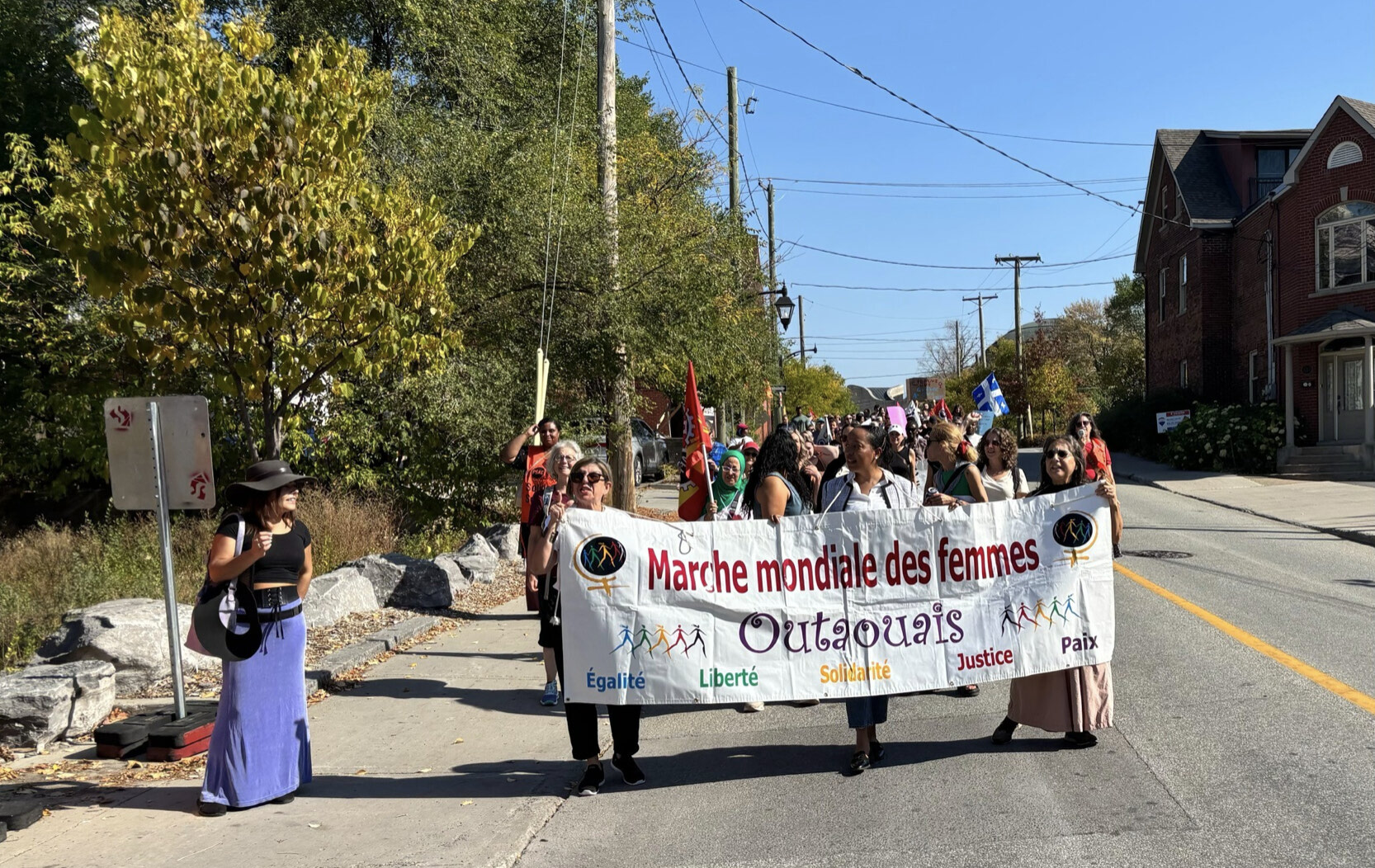
Despite a rising toll of women killed by intimate partners in Quebec, the province continues to grapple with a system that consistently fails to intervene before it is too late. Photo: Courtesy of AGIR Outaouais Facebook page
Quebec's femicide crisis and the system that keeps failing them
Tashi Farmilo
A fire alarm woke residents of a Gatineau apartment tower on May 7. When they reached the stairwells, there was smoke and screaming. Police, responding to reports of a small blaze, found Shannon Jean Hickey, 30, dead inside one of the units, her partner Tien Quan Vu, 34, dead beside her. It was, in its essential features, a story Quebec had already lived through many times this year.
Ten women have been killed in the province in the context of intimate partner violence since January. Among them was Tadjan'ah Désir, 31, who died in hospital after allegedly being thrown from a third-floor Montreal balcony on New Year's Day. Mary Iqiquq Tukalak, 54, was killed by her husband on January 5 in the northern Quebec community of Puvirnituq; he then took his own life. Her children found her body, and police confirmed a prior history of domestic violence in the household. The body of Susana Rocha Cruz, 44, was recovered from the St. Lawrence River near Quebec City on January 13; her former partner was charged with her murder. On January 18, Véronic Champagne, 40, was stabbed to death in her Montérégie home by a partner who had refused to accept her departure. Their young daughter was in the house.
The year before, there was the death of Gabie Renaud. She was 43 years old when she was killed in her Saint-Jérôme apartment in September 2025. Her body was not found for three weeks. The man accused of her murder had been arrested roughly thirty times and convicted at least six times for domestic violence, had served a three-year prison sentence in 2021, and had breached his probation conditions approximately fifteen times.
A law now bears her name. Modelled on England's Clare's Law, the Gabie Renaud Law was tabled in the National Assembly in early May 2026. It has broad cross-party support, but with only five weeks remaining in the parliamentary session, it has not yet passed. If adopted, it would give individuals the right to ask police whether a partner has a history of violent behaviour. Manitoba and Saskatchewan have already had comparable legislation in place for years. Quebec is still catching up.
Louise Riendeau of the Regroupement des maisons pour femmes victimes de violence conjugale has argued that any disclosure mechanism must extend beyond court files to include police interventions and child welfare contacts. The right to know is only useful if what is known reflects the actual pattern of behaviour, not merely the portion of it that resulted in a guilty plea.
There is a deeper problem still, and it concerns what the disclosure of danger actually makes possible for a woman in an abusive relationship. The assumption embedded in calls for better information is that women who know their partners are dangerous will leave. But as Marie-Emmanuelle Genesse, a domestic violence researcher at Queen's University, has pointed out, leaving is precisely the moment of greatest risk. Women who have been threatened know this. They are not staying out of ignorance or passivity. They are making constant, often accurate calculations about when it is and is not safe to act. The statistics consistently bear out what they already know from experience: intimate partner homicide spikes at the point of separation. A man who cannot control a woman through presence will sometimes choose to eliminate her at the moment when she asserts the right to go.
This is why femicide is not best understood as a sudden explosion of violence but as the endpoint of a much longer process. Abusive relationships typically begin not with harm but with intensity, possessiveness dressed as devotion, jealousy framed as love. Control is established gradually: access to money is restricted, friendships are discouraged, family contact is made difficult. Over time, a woman's sense of her own perceptions is eroded. She is told repeatedly that her experience of events is wrong, that the harm she suffers is her own fault, that no one would believe her account of what happens behind closed doors. Physical violence, when it arrives, does not define the relationship so much as punctuate it. Between incidents there is often remorse, affection, and normalcy. This cycle is not a sign of a complicated love. It is a mechanism of control, and it works.
Quebec's shelters received over 60,000 requests for help in the 12 months ending March 2025, roughly 20,000 of which were for emergency beds. Reports of intimate partner violence in the province have tripled over the last decade. Advocates and researchers have been consistent in identifying the underlying cause: not individual pathology, not a failure of anger management, but a broader cultural tolerance for the subordination of women, the belief that male control over a female partner is natural and its loss intolerable. That belief does not exist in isolation. Researchers have noted the rising volume of misogynistic content in online spaces and in schools. Its normalization has not been without consequence.
Passing the Gabie Renaud Law before the session closes would be meaningful. Expanding its scope beyond court records to capture how abuse actually moves through institutions would make it more so. But a single piece of legislation cannot substitute for adequately funded shelters, accessible legal aid, trained police and prosecutors, and a sustained cultural reckoning with the conditions that produce this violence.