


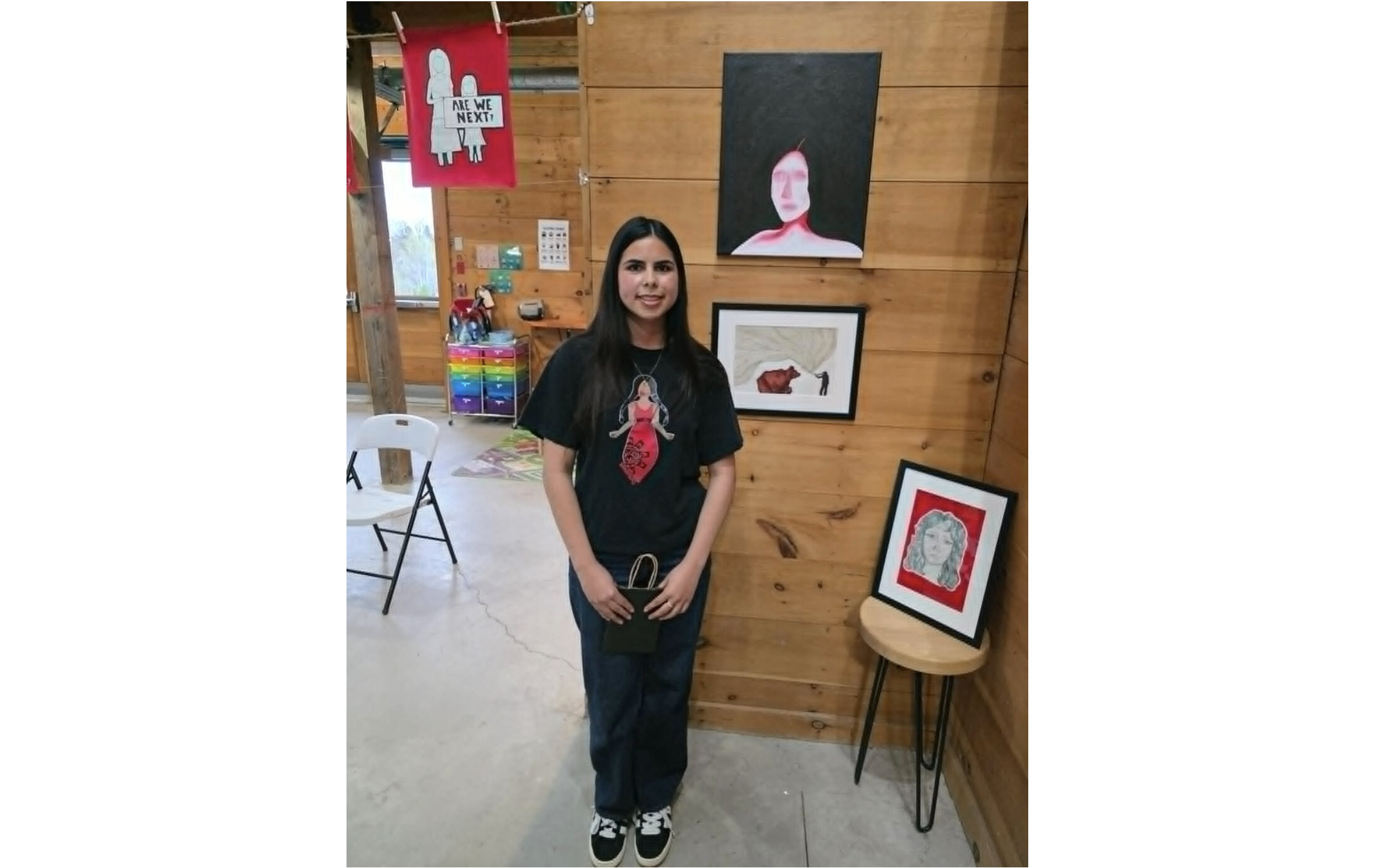
Ayah Hafez-Sarazin, a grade 10 student at Merivale High School, organized an art show in Gatineau on Red Dress Day after discovering that none of her classmates had ever heard of the crisis of Missing and Murdered Indigenous Women, Girls, and Two-Spirit People. Photo: Tashi Farmilo
Red Dress Day at the Gatineau-Maniwaki Native Friendship Centre
Tashi Farmilo
Every year in Canada, Indigenous women, girls, and Two-Spirit people go missing and are murdered at rates dramatically disproportionate to their share of the population, and every year the cases receive a fraction of the attention. A grade 10 student put together an art show in Gatineau on May 5, the National Day of Awareness for those victims, because her classmates did not know the crisis existed.
Community members, elders, and families gathered at La Ferme Moore for "The Stolen," an event held in partnership with the Gatineau-Maniwaki Native Friendship Centre that opened with a prayer and an honour song, moved through an original art exhibition, and invited attendees to participate in making red dress pins and enter a red ribbon skirt draw fundraiser. It was not merely an art show. It was a lesson, a memorial, and an act of resistance, all held in the same room.
May 5th is observed across Canada as Red Dress Day, the National Day of Awareness for Missing and Murdered Indigenous Women, Girls, and Two-Spirit People. The symbol is deliberately stark: an empty red dress, hung in public, representing the shape of someone who is gone. Red holds spiritual significance in many Indigenous traditions as a colour the spirit world can see, and the emptiness of the dress is the point. These are not statistics. They are people whose absence has a form, and that form is not being looked for hard enough. For the families still waiting, Red Dress Day is not a symbol. It is another year without answers.
The crisis it commemorates is known as MMIW2S. In Canada, Indigenous women account for roughly five per cent of the female population but have represented a quarter or more of all female homicide victims. Countless cases have gone unsolved. Many were never seriously investigated. Families have spent years fighting simply to be heard.
Ayah Hafez-Sarazin, the grade 10 student at Merivale High School in Ottawa who built the show, is Anishinabekwe from Pikkwakanagan First Nation and Kitigan Zibi Anishinabeg, and Ojibwe from Chochiching. She belongs to the wolf clan. This is her community, her people, and the event grew directly out of something she had witnessed throughout the school year: that the people sitting beside her in class had never heard of MMIW2S.
"I'll say MMIW2S and no one knew what it was," she said. The education system had not given them the language. She concluded that if the institution would not do it, she would.
Hafez-Sarazin is clear-eyed about why the crisis persists. The cases do not receive the resources or attention they warrant, she said, and what little scrutiny they do attract tends to fade quickly. Stereotypes, she explained, make it easy for broader society to look away, and looking away has become a kind of policy. "People often push them aside after a while because of different stereotypes," she said. She does not accept that as an inevitability.
When asked what she thought would change things, she answered without equivocation. "More events like this, more raising awareness, more young people getting to learn about this," she said. "We're the ones who end up making the change of the future. Just educating everyone, I think, is the most important thing." A young person who understands this crisis, she suggested, is already a different kind of person than one who does not.
This year, Ayah was elected as Indigenous Student Trustee at her school, a formal role she intends to use to organise more events and push for these conversations to become a regular part of school life. Her hope for the evening was that no one left it unchanged. Her hope for the future was more demanding than that.
"I hope in the future we don't end up having to do these events," she said, "and they're integrated into our education system."